
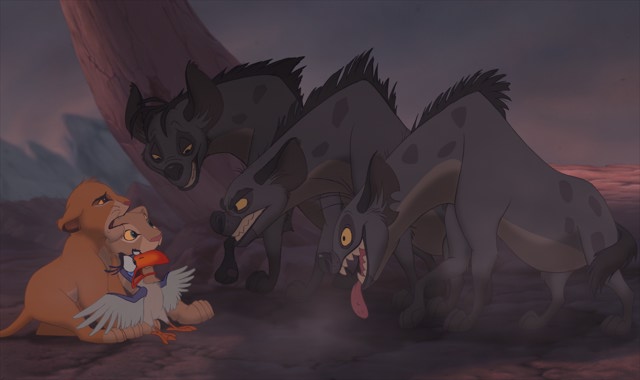
Let me provide an anecdote (in the spirit of Paul Krugman) - let's say the global economy is the circle of life (will come back to this concept later)... say, in Lion King. Substitute the exchange money with the exchange of hunted animals. And for example's sake, let's pretend that the animals at the top of the food chain are very intelligent and know advanced math. They are able to accurately minimize number of hunted animals, while sustaining each animal population. Throughout the year, lions and hyenas are particularly found of eating gazelles and giraffes. Pride Rock and the Shadowlands, the dwelling of the lions and hyenas, respectively, each have a proportionate ratio of gazelles and giraffes. However, of late, many of the giraffes have wandered into Hyena territory.
Let's pretend that the Hyena clan feels that they are being unfairly treated by the lions (just like in the movie; however, keep in mind that China's intentions in fixing their currency is by no means driven by Populist ideal) because they want gazelle and make a deal with the lions via Scar to hunt additional gazelle. The hyenas propose that for every five gazelle they claim, they will allow them one giraffe, an increase from an original three gazelle to one giraffe that was fixed earlier. The Lion clan agrees to these terms but as they are fewer in number in their pride, they do not realize that they will eventually run out of gazelle. Soon, the gazelles start to drop in number at Pride Rock and the hyenas hoard up giraffe, driving them all to the Shadowlands (let's assume plant life is sustainable there). Many innocent lions and lionesses begin to stave. The lions approach the hyenas and request that they adjust their gazelle to giraffe barter to a more even ratio in their favor to even trade, as a trade deficit is now acknowledged by them. The hyenas won't relent, asserting that it is precisely this ratio which sustains their populace, which has increased considerably since when they first made their initial deal. They even go so far as to hunt more gazelle without exchanging giraffe, creating an even more uneven ratio. And because they have made various alliances with other carnivores, supplying them with giraffe, the lions don't have many choices left in bargaining with the hyena. They can now either continue to argue with the hyenas, encourage the other animal herds to pressure them for an adjusted rate of exchange, or fight them, which would be viewed as unacceptable by the rest of the animal kingdom. By the way, the Lion pack represents America.
Note: if anyone wants to make a more accurate model, be my guest. I am aware that gazelles to giraffes aren't the only form of trade that can be made. Ostriches, elephants, edible packaderms, etc can be considered. A flaw with this anecdote is the absence of a "medium of exchange" - money. However, I just really wanted to try this out.
--
My next post will hopefully provide some enlightenment on the potential catastrophe(s) that may be caused by China fixing their artificially valued currency. This including China's economy inability to justify their market and power - superficial as it is. Think of vacancies. Will China's market crash? My professor has called the country "soulless" and I agree, having visited the place. I cannot say the same about Hong Kong, and hope to make a trip out there someday. I don't feel comfortable making inferences on the statuses of other countries without first visiting them and seeing for myself what's what - observation is a crucial thing. There should always be some honor in it to best acquire all data. Anyway, my prof called the country that particular word because most of the country's demographic consists of villagers, peasants, and farmers. It is only the clustered coastal cities that serve as a bastion of centralized wealth - and it is artificial. The counterfeit market makes it harder to figure out China's actual GDP. How can someone in Shanghai make ends meet as a wealthy storekeepr selling counterfeit designer sunglasses while a poverty-level farmer out in the countryside toils day in and day out, creating actual products of worth and necessity? Soulless. I dearly hope that one day countries propel themselves out of this mad paradox.
